Showing posts with label Ford. Show all posts

Wednesday, September 28, 2011

2012 Ford Focus ST-R - Auto Shows review and news


While the majority of hot-hatch fans will be most excited about the debut of the production Ford Focus ST at the 2011 Frankfurt show, the engineers back in Dearborn would like to make sure the car also finds love from those who spend just as much time on closed circuits as they do on freeways. As such, the production car shares the stage in Germany with this turn-key racer, known as the Focus ST-R.
Like Ford’s fleet of Mustang racers, the ST-R doesn’t stray too far from its production counterpart. The body goes essentially unchanged, a 2.0-liter EcoBoost engine lives under the hood, and sitting alone inside an otherwise stripped interior is a production dashboard and center stack. (Ford even fits pedestrian-Focus door handles to the inside of the ST-R’s otherwise bare-metal doors.) To prepare it for race duty, engineers at Ford Racing in North America—with technical support from Ford’s Global Performance Vehicles division—added an FIA-regulation roll cage, upgraded brakes, and a retuned suspension that makes none of the compromises something employed on a daily driver does. All a customer needs to do is add communications equipment—and perhaps some sponsor decals, if said customer happens to be so fortunate.
With the Focus ST-R, Ford intends to raise awareness of itself as a serious motorsports power, and the company has its eyes on more venues than drag strips and places where hairy people drink Budweiser in the infield. A Focus is already running in the British Touring Car Championship, and of course the smaller Fiesta is well-known in rally-racing circles and by the Ken Block fan club. Might we be seeing a Focus ST-R in Monster Energy Drink livery soon?
Availability will start in North America, where Ford hopes teams will race the ST-R in Grand-Am ST, World Challenge TC, or the Canadian Touring Car series. When cars are offered overseas, we’ll no doubt see one or two running with the VW GTIs and other sport compacts that run the Nürburgring 24 Hours and other such events. Back here in the States, interested parties can buy an ST-R right from a local Ford dealer. You’ll need about $100,000. That might sound like a lot for a Focus, but isn’t expensive at all for a turn-key race car. And, if you want something cheaper, there’s always the road-going ST.

Tuesday, May 10, 2011

Fastlane Starts Tuning Ford F-150 EcoBoost V-6


Fastlane-f150-3-560
Traditional truck buyers aren't the only ones getting their hands on the first 2011 Ford F-150 EcoBoost V-6 trucks. Tuners are, too. Our friends at Fastlane in Houston are already squeezing more power and performance from the advanced direct-injection twin-turbo engine.
Bolting on a set of high-flow catalytic converters with wide pipes added 30 horsepower at the rear wheels, as measured on Fastlane's chassis dyno. They also lowered the truck, mounted a PLX boost gauge inside on the A-pillar to show turbo boost levels, and painted the engine's beauty cover to match the exterior and skinned it with a carbon-fiber-style laminate.
We spent 30 minutes behind the wheel to check out its peformance. Despite the lowered ride height, the F-150 still rode great on the highway. The biggest difference was the improvement in zero-to-60-mph times compared with what we've previously measured.
Fastlane-f150-2-560
We clocked Fastlane's EcoBoost F-150 (3.73 rear axle) at 6.07 seconds from a full stop to 60 mph with our VBOX test kit. That's compared with 6.79 seconds (3.55) and 6.82 seconds (3.73) in two stock F-150s we've previously tested. We also clocked the truck in the quarter-mile at 14.97 seconds at 92.61 mph. Not too shabby for a relatively simple hardware upgrade.
Fastlane says the best is yet to come, but it's going to take a while longer. Fastlane's tuning braniacs are still trying to crack the strong encryption Ford has put in place around the EcoBoost's electronic control unit. Once they do, they plan to remove the stock turbos and replace them with high-performance BorgWarner EFR turbos that feature lightweight titanium turbine wheels for faster spool-up.
We'll be paying close attention to Fastlane's efforts to push the performance of Ford's EcoBoost F-150. Stay tuned.
Fastlane-f150-1-560
by news.pickuptrucks.com

Monday, May 9, 2011

Mustang V6 Performance Package Renamed for Pioneering Black Metal Band?

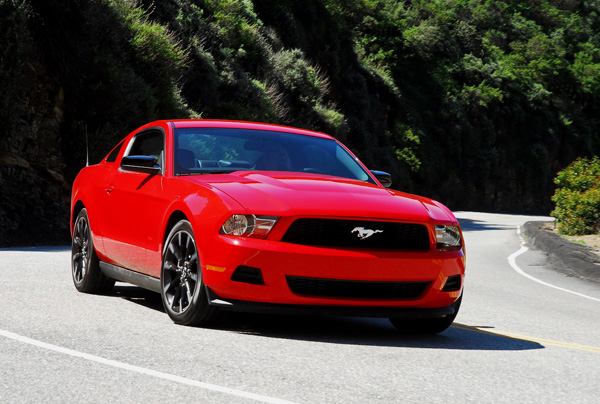
Ford Mustang V6
When Mayhem vocalist Dead killed himself in 1991, the Norwegian band’s founding guitarist Euronymous, upon finding the corpse, allegedly went cannibal. Two years later, Euronymous was murdered by Burzum frontman Varg Vikernes while the pair had been working on a plan to blow up a cathedral with its roots in the 11th century. At this point, you’re asking yourself, “What does all this Scandinavian tragedy masquerading as farce and death metal have to do with the Ford Motor Company?”
As it turns out, possibly only everything. Ford launched a Facebook contest to rename the Mustang V-6 Performance Package, and after more than 3000 submissions, “Mayhem Mustang Package” is the moniker that rose to the top of the heap. The specs themselves remain the same: the 305-hp standard-equipment V-6, remapped stability control, a 3.31 rear pumpkin, a strut-tower brace, and brake/suspension bits sourced from the GT (the rear lower control arms come from the GT500), plus unique 19-inch wheels shod with Pirelli rubber. Fitting the lot to a 2012 Mustang costs $1995.
Given that the winning submission came from somebody Ford’s describing only as a “North Carolina resident,” we’re wondering if noted metal aficionado and Durham denizen John Darnielle of indie-rock darlings the Mountain Goats hasn’t just found himself a free three-year lease on a Mayhem-equipped Mustang, the prize for submitting the winning name. If so, we’re hoping he springs for an airbrushed Euronymous-death-mask hood mural.
by blog.caranddriver.com

Saturday, May 7, 2011

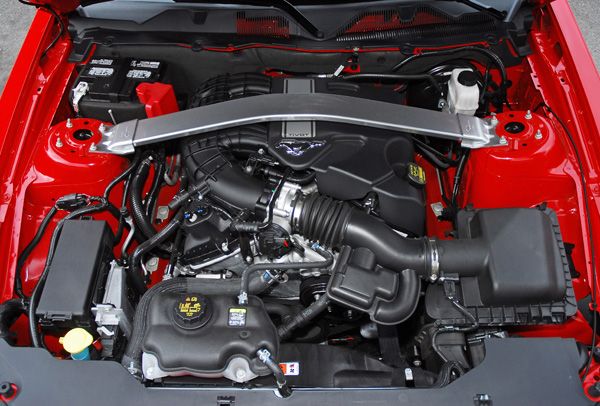
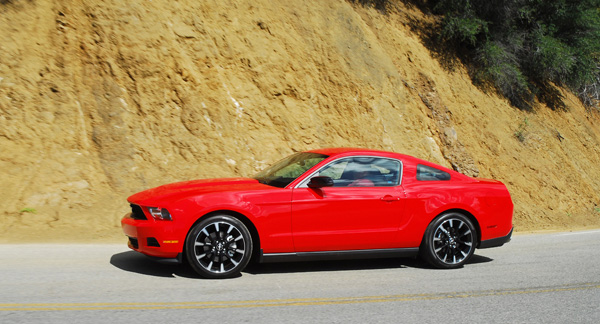
2011 Ford Mustang V6 Review & Test Drive


‘MORE POWER AND PERFORMANCE’

It is great to be an automotive enthusiast in today’s marketplace.  Engines are getting smaller, more powerful, yet give high mileage specs.  As a result of global competition automobiles are being built better with stronger frames while adding more comfort and convenience inside.
The new 2011 Ford Mustang V6 is a fine example of this trend with a new high-performance, all-aluminum Duratec 3.7 liter DOHC Ti-VCT V6 that generates 305hp, 280lb.ft. of torque, and 31mpg/highway, while mated to a six-speed automatic transmission-the first car ever to achieve this combination.

The all-new six-speed automatic is joined by a six-speed short-throw manual transmission for the ‘shift-it-yourself’ crowd, while handling and cornering are bolstered by the addition of electric rack & pinion power assisted steering (EPAS), and a host of suspension improvements.
It was only a couple of years ago that the 4.6 liter V8 in the Mustang GT had 300hp and you shifted with only a five-speed manual or four-speed automatic.  Wow!  Have times changed.
The new Mustang’s 3.7 liter Duratec 24-valve V6 uses advanced engineering to deliver its power and economy.  Twin independent Variable Camshaft Timing (Ti-VCT) adjusts the valvetrain in microseconds.  Aluminum construction means light weight.  It’s an engine designed to crank out torque down low, rev to 7,000rpm and deliver the mechanical music sports coupe lovers crave everywhere in between.

The high output is due largely to Ti-VCT, which allows variable control of valve operation across the rev range.  The variable cams operate on a Direct Acting Mechanical Bucket (DAMB) valvetrain using polished buckets to reduce friction.  The end result is as much as a 3% improvement in fuel economy and a 10% improvement in power output versus traditional engines without these advanced features.
Ti-VCT is complemented by specially tuned composite upper and lower intake manifolds for efficient air delivery and lighter weight.  Ignition power is delivered by a high-energy coil-on-plug design, while piston-cooling jets and a lightweight die-cast aluminum cylinder block improve the durability and efficiency of the 3.7 liter V6 design.  A die-cast aluminum deep-sump oil pan provides 10,000 mile change intervals, saving you money on maintenance and resulting in less waste in oil disposal.

Engineers also worked to ensure aggressive, high-performance sounds come with the new engine, from intake to exhaust.  Not only does the retuned air intake system minimize losses, it also provides you with a very satisfying intake rush on hard acceleration.  The all-new dual exhaust system is mellow at idle but opens up with a loud howl, just a few decibels less than the GT, when you mash your foot down on the throttle, letting new Mustang V6 owners know that they are behind the wheel of a world-class sports coupe.
Drivers can get the most of the new V6 engine’s output using either a standard, all-new six-speed manual gearbox or an optional six-speed automatic transmission.  Both come with the flexibility and fuel economy benefits of six forward ratios regardless of whether drives want to shift for themselves or not.

Drivers who prefer a manual gearbox will love the short throws and direct feel of the Tremec 6060 transmission along with the relaxed cruising permitted by the extra top gear ratio.  Customers choosing the automatic will be pleasantly surprised to find the advanced six-speed transmission does not sacrifice fuel economy-or performance-for convenience, delivering 31mpg highway with crisp, quick shifts that maximize torque and horsepower.
The manual transmission delivers 29mpg highway, and both deliver 19mpg city.
The automatic transmission also features a grade-assist or ‘hill mode’ to improve drivability on hilly terrain.  This technical innovation uses vehicle input-acceleration, pedal position, vehicle speed and brake status-to automatically determine the correct gear ratio while on an incline or decline.  Hill mode eliminates sixth gear, extends lower gear operation on uphill climbs, and provides additional grade or engine braking for coast-downs.
The standard 2.73 rear axle provides an ideal blend of cruising fuel economy and acceleration, aided by the wide ratio spread permitted through the use of six forward speeds in the gearboxes.  Performance enthusiasts can select the 3.31 rear axle ratio for better off-the-line launch characteristics by choosing the optional Performance Package, (which I will talk about later).  Both transmissions come with a standard limited-slip differential to put more efficiently put the higher horsepower/torque down on the pavement.  This new Mustang V6 with the Performance Package is the fastest to 60mph from a standstill of any V6 Mustang with times as low as 5.1sec.

With so much more horsepower and torque, the 2011 Mustang receives enhancements to its chassis to maintain the outstanding balance and driving behavior Mustang owners expect.  Damper tuning and spring rates were revised to provide a smooth highway cruising ride, while new rear lower control arms and stiffened stabilizer bar bushings improve stiffness and handling for better cornering response.
You easily slice through corners with an independent MacPherson strut setup up front including reverse L-links, coil springs, and a 34mm hollow stabilizer bar.  The 3-link solid axle rear setup includes coils springs, gas-charged shocks, a Panhard rod that is further refined, and a 22mm. solid stabilizer bar.
When you order the Performance Package, more expensive sport coupes should watch their rearview mirror for you coming up as the package includes a unique electronic stability control calibration with sport mode for performance driving, a strut tower brace,
firmer GT suspension settings, riding on 19in.X8.5in. machine painted, light aluminum wheels wrapped with Pirelli 255/40ZR19in. P-Zero low-profile, high-performance summer tires.  This is the greatest performing V6 Mustang ever!

While Mustang’s aerodynamic improvements were designed mainly to improve fuel economy, engineers also adjusted the vehicle’s front/rear lift balance.  The result is a car that tracks more securely and feels more ‘planted’ to the road surface at higher speeds, helping to keep the tires in better contact with the pavement.  The aerodynamic enhancements include a new front fascia with a new splitter and airdam, full perimeter lower body kit, tire spats on the rear wheels, modified underbody shields, rear lip spoiler and an added rear decklid seat.  It looks as good as it drives!
The addition of EPAS marks a new era in driving dynamics for Mustang owners.  Steering effort at parking lot speeds is reduced, while high-speed and highway feel is improved for more precise steering and handling.  because the belt-driven power steering pump is eliminated, EPAS provides a quieter vehicle with few components drawing engine power.  The steering response from my inputs was precise and very quick thanks to the strut tower brace that comes with the Performance Package.  There is virtually no slush as on center wheel behavior is spot on, and feel for the road is excellent.  They have it plugged in perfectly as I felt even more a part of the car when I was putting the Mustang through its paces.
EPAS also enables new technologies that adjust for minor driving annoyances.  Drift-Pull Compensation adjusts the steering to correct for crosswinds and minor road crowning, while Active Nibble Control helps eliminate the ‘shimmy’ felt at high speeds when a wheel is out of balance or a brake rotor is warped.  Both conditions are alleviated by EPAS independent of your input, helping ensure Mustang delivers a smooth, comfortable driving experience in all conditions.  Standard AdvanceTrac electronic stability control plus full speed traction control also helps you maintain your chosen path when driving over slick surfaces or when you take the new V6 powered Mustang to its limit of adhesion during spirited driving times.  You can of course shut the stability control system off with a push of a console-mounted button to let the rear hang out a bit during hard cornering.
When the time comes to slow things down, the new larger power-assisted steel disc brakes do a great job.  Up front are 12.4in. vented discs clamped with dual-piston aluminum calipers, and the rear contains the same 11.8in. vented discs clamped with single-piston aluminum calipers.  Standard ABS ensures controlled stops in panic situations and when braking hard on slick pavement.
For 2011, Mustang also ups the ante on technology and convenience features including a standard driver’s message center in the instrument cluster and integrated blind-spot mirrors in the sideview mirror housings.  Ford’s MyKey system, designed to encourage safer teen driving and seat belt use, also is newly available on Mustang.  MyKey allows owners to program the vehicle key using the driver’s message center to incorporate features such as limited top vehicle speed and audio volume, a traction control system that cannot be deactivated, a persistent Belt-Minder seat belt reminder and various speed alert chimes.

Mustang’s technological advances are also incorporated in the structure of the car, where improvements in body stiffness contribute to the coupe and convertible’s driving performance and have a parallel benefit in accident protection.  A stiff vehicle structure like that found on Mustang help protect the cabin from deformation and intrusion in an impact.  Mustang also uses high-strength steel in its body structure and ultra-high-strength steel in the door intrusion beams for additional side-impact protection.
The front structure’s crush zones are computer-designed to absorb energy in a controlled manner and help dissipate it before it can reach the passenger compartment.  Ford engineers have run thousands of design iterations of the Mustang’s front rails to arrive at an octagonal shape that helps spread crash forces evenly to aid in protecting occupants.
State-of-the-art technology adds to the convenience and safety of the 2011 Mustang, from the availability of the latest version of Ford SYNC, with applications such as Traffic, Directions & Information, 911 Assist, and Vehicle Health Report, to standard AdvanceTrac Electronic Stability Control, which complements the all-speed traction control and standard ABS.  Additional standard safety equipment includes the Personal Safety System which features dual-stage driver and front-passenger front/side airbags, seatbelt pretentioners/load limiters up front, side curtain airbags, Belt Minder, and 3-point safety belts in the rear.
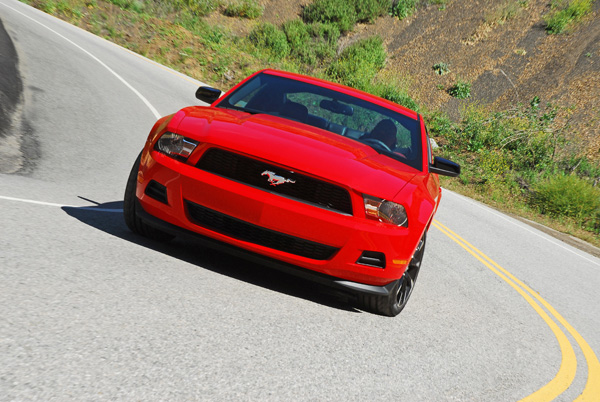
For 2011 Mustang exterior styling reflects the successful 2010 redesign with new headlamps, lower fascias, fenders and grille capped by a powerdome hood that adds to the muscular appearance while functionally allowing for enhanced air cooling of the engine.  Mustang’s washer-fluid nozzles are tucked into the cowl, while the antenna resides at the rear, both changes creating a cleaner appearance while also reducing wind noise.
Front fenders feature taut, sculpted wheel flares, like a tight skin stretched over the wheels.  Classic spear character lines on the doors leads to a modern indication of ‘hip’ rear fenders.  The modern design provides Mustang with aggressive, forward direction, like it’s ready to jump.  From the side you’ll notice the steeply raked A-pillars, fastback roof design, tinted rear side glass, deep lower side extensions and aerodynamically styled sideview mirrors giving the new Mustang V6 a low, long sexy look.
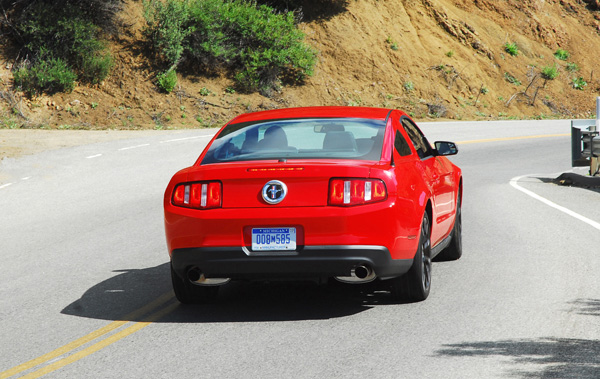
The rear end design features aggressively angled corners, a sculpted decklid with integral lip spoiler and a prominent badge.  Other than the chrome Pony badge in the center of the grille and the rear badge, there are no other badges proclaiming the V6 engine under the hood.  The dual, 4in. wide, polished aluminum exhaust tips shows drivers following you that this is a real performance machine.  Mustang taillamps feature three LED bulbs firing sequentially from the inside for turn indication.  The sequential bulbs were a distinct Mustang feature in the 1960’s, while the vertical reverse lamps evoke a modern version of the Ford classic three-lens taillamp.
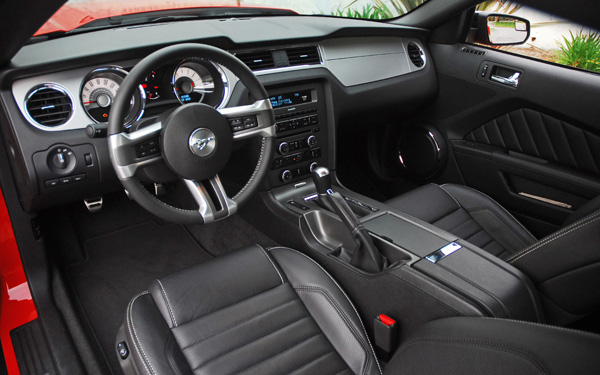
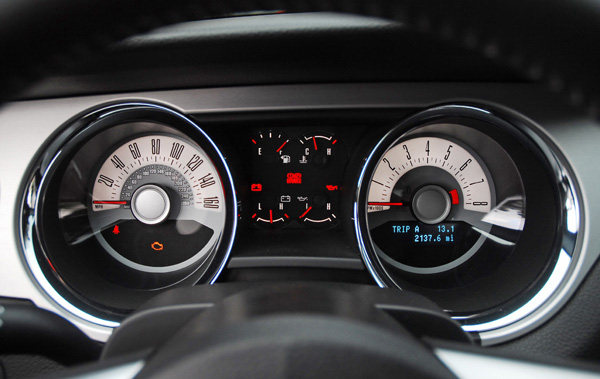
Inside, the new speedometer and tachometer gauges are housed in a one-piece instrument panel with excellent fit and finish.  The design is crafted in seamless soft-touch TPO (thermoplastic Olefin) skin encompassing available genuine aluminum-finish panels.

The new instrument cluster graphics, including a speedometer that reads 160mph and a tachometer that reads up to 8,000rpm reflects the free-revving style of the new V6 engine.  The chrome-ringed gauges and dual-vane air outlets are precisely crafted and positioned, and the instrument panel, center stack and console flow as one shape-another strong connection to Mustang heritage.  The tilting, leather wrapped steering wheel feels perfect in your hand and features buttons for the cruise-control and audio system.  The classic ribbed sport bucket seats are comfortable and very supportive.  The nubby stick shift is perfectly placed for quick, easy use.  All buttons, switches, and dials are within easy reach and fully illuminated for safe nighttime driving.
Additional lightweight soundproofing measures help filter unpleasant, high-frequency noises, while a tuned intake and dual exhaust add the sounds Mustang buyers relish.
Occupants also benefit from new door seals and rear wheel arch liners that reduce road noise for a quieter, more enjoyable drive, all with minimal weight gain compared to the 2010 model.
Standard features in the Premium model Mustang that I tested included 6-way leather trimmed driver’s seat, AC, ambient lighting, message center, Shaker 500 audio system, split-fold 60/40 rear seat, front door mats, aluminum-faced foot pedals, dual map lamps, dual vanity mirrors, dual cupholders with flip-up lid, deep storage bin with flip up cover, a deep glove box, storage slots in each door, 2-12-volt power plugs, remote trunk release, driver personalization control, variable, intermittent wipers/washers and aluminum Mustang signature door entry skid plates.
The new, more powerful V6 Mustang is the best all-around Pony car on the market with a new, more efficient engine, two new six-speed transmissions, revised front and rear suspensions, more powerful steel disc brakes and an interior that is sporty, comfortable and quieter than ever before.
In 2011, the V6 has stepped up its power but to make the appearance of the car stand out more why not add some 2011 Mustang accessories.
The base price for a Premium edition V6 Mustang is just $25,845.00 and my nicely loaded test vehicle came in at just $27,840.00.
by automotiveaddicts.com

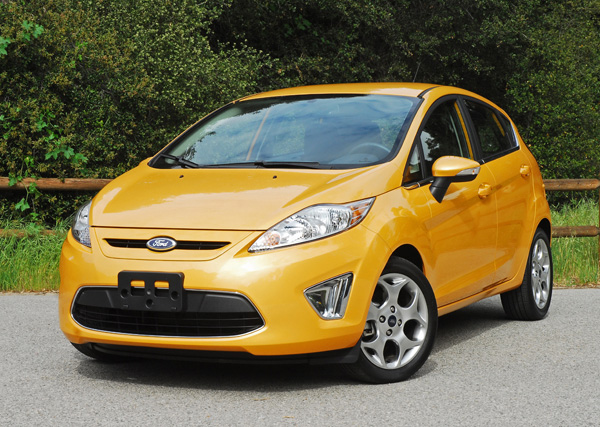
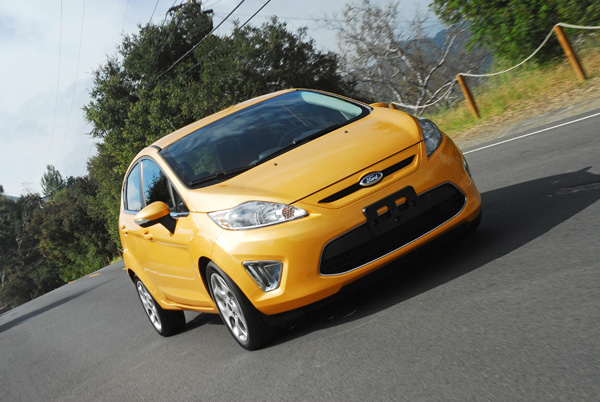
2011 Ford Fiesta SES – ‘Offering European Design & Engineering At An Affordable Price’


Ford has finally seen the light by bringing to American consumers Europe’s #2 best selling car and Ford’s top-selling vehicle, the Fiesta.  The all-new Fiesta offers American consumers a stylish, fuel-efficient alternative at a very reasonable price starting at just $13,995.00 and returning segment leading specs of 40mpg/highway and 28mpg/city.
Designed and engineered in England to be versatile, personal and adaptable, Fiesta delivers best-in-class safety, convenience and connectivity with segment-exclusive SYNC voice-activated communications system, and an expressive color palette and available body graphics.
The all-new Fiesta offers 15-class-exclusive technologies, adding luxury and convenience usually found in vehicles at significantly higher prices.  Fiesta is the next milestone under the ONE Ford plan to design and develop vehicles that meet the differing needs, wants and expectations of customers around the world.  More than 500,000 new Fiestas have already sold to customers in Europe and Asia.  It is about time that we have the opportunity to own, drive and enjoy this small compact car that is available as a four-door sedan or five-door hatchback.

Kinetic design imparts a sense of movement-even while standing still-harmonizing character elements to reflect Ford identity, enabling Fiesta to project its own air of confidence, style and individuality.  Fiesta targets a youthful ‘design progressive’ mind-set, a consumer group that values style and diversity as worthy assets.
It is also a great young family sedan with ample room for two adults up front and three young children in the rear seats with storage room for shopping forays.  With a rating of 28mpg/city and 40mpg/highway it makes for a great commuter vehicle for any young person pursuing their first job.
Up front Fiesta sports the global Ford face, centering the Blue Oval badge on the grille over the signature inverted trapezoidal lower grille opening.  These subtle cures engender familiarity across the portfolio, providing aesthetic linkage between the distinctive new Taurus, the fuel-efficient mid-size Fusion and the bold Fiesta.

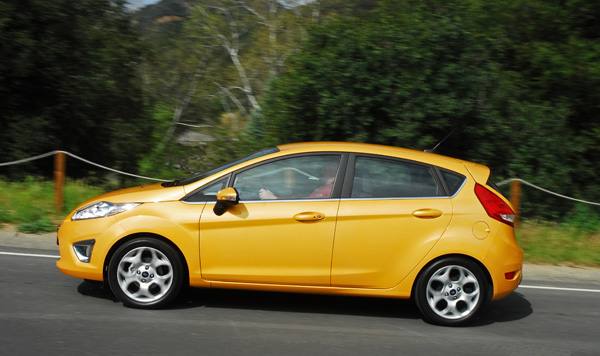
Adding two eyes to the Fiesta face are sweeping, elongated halogen headlamp clusters that frame and connect the hood to muscular, sculpted front fenders.  The silhouette also shows a deep scallop in the doors, wedge shape with a rising chrome strip at the beltline.  The power-remote/heated side mirrors are aerodynamically designed and the lower side extensions give the car a more aggressive stance from the side.
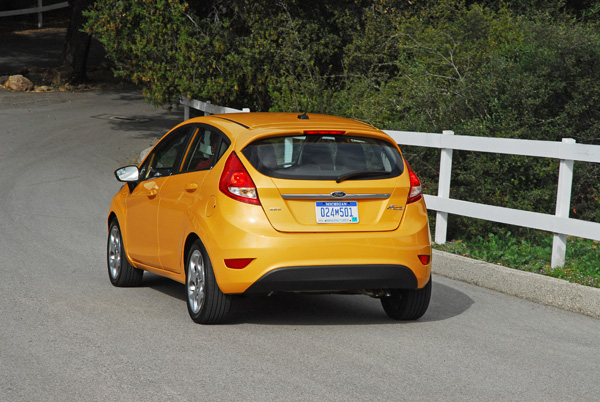
At the rear of the car many design elements merge, including the chamfered rear liftgate glass, the low roofline sweeping into a spoiler and dramatic taillamp clusters with honeycomb detailing mounted high in the five-door’s corners.  Muscular rear quarter panels that are wrapped tightly, there is a black diffuser finisher at the bottom of the bumper, and dual exhaust pipes drawing the eyes to the 16in. alloy wheels/tires and Fiesta’s confident stance.
The Fiesta design is further enhanced with a choice of nine vivid new colors, from bright magenta through lime squeeze to blue flame, Fiesta’s broad color pallet-more available colors than any other segment competitors-instills vibrant individuality.  My test Fiesta was painted yellow blaze metallic tri-coat and drew the attention of everyone when I parked the car.
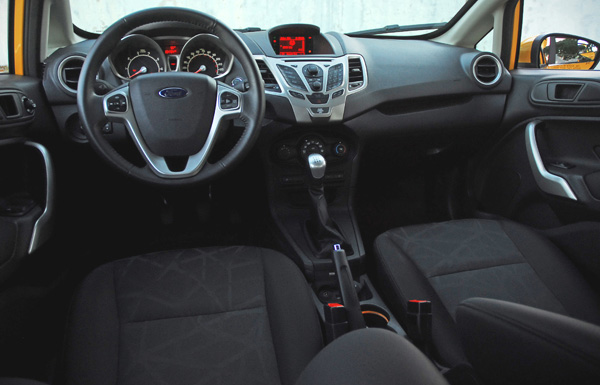
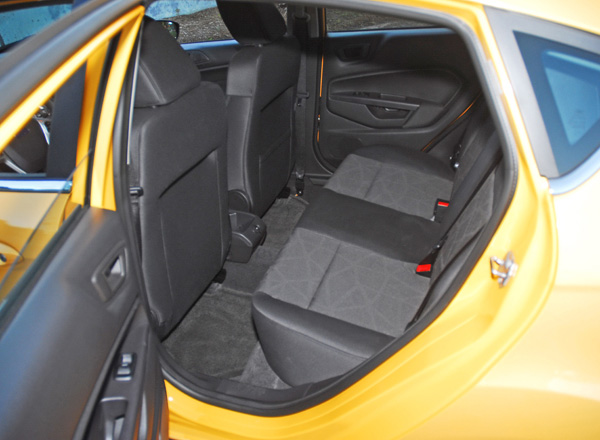
Fiesta is as dramatic on the inside as it on the outside.  Boldly sculpted surfaces, contrasting colors and comfortable, soft-touch, supportive materials make the interior as individual as the owner.

The dashboard center stack-focal point of the new Fiesta interior-was designed to feel as useful and familiar as the keypad on a mobile phone.  You get first row supportive and comfortable bucket seats with a 60/40 split second-row seatback.  Up level Fiesta’s also offer leather with sporty contrast accent color piping.  My test Fiesta came with a beefy, leather wrapped steering wheel with tilt/telescoping column for the perfect feel, reach and angle.  Soft, sculpted surfaces and the centerstack layout provide the Fiesta with a sense of harmony.  Intuitive switchgear placement, comfort zone seating and optional ambient lighting allow a driver to maximize the mood with seven complementary colors-switchable among three levels of intensity-for interior accent lighting.  The instrument cluster is straight-ahead and easy to see and understand with a trip computer to let you know if you are getting the most mpg from your Fiesta.  All dials, switches and buttons are within easy reach and fully illuminated for safe nighttime travel.
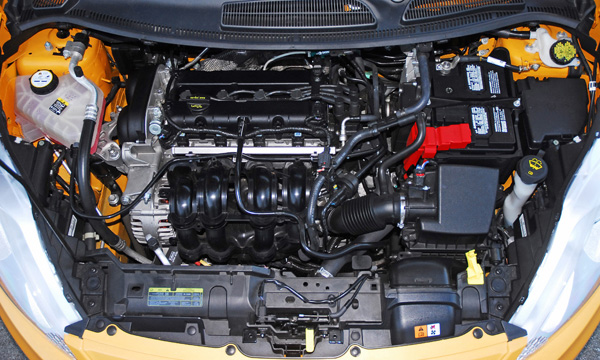
Fiesta’s flowing sculpted hood covers a 1.6 liter DOHC I-4 engine with 120hp and 112lb.ft. of torque.  Spirited performance and fuel-efficient economy are signature attributes with the Fiesta as it gets 40mpg/highway, the best-in-class.  The Fiesta’s advanced 1.6 liter engine features Twin Independent Variable Camshaft Timing allowing the engine to be downsized for fuel economy while continuously optimizing camshaft phasing for throttle response, performance and flexibility. Big results from a small package are possible with several new technologies in this new global engine, including an advanced new front end accessory drive (FEAD) belt with stretchy dynamics to improve the engine’s thermal dynamics.  The elasticity in this new drive belt eliminates the need for a belt tensioner and contributes to overall fuel economy.

Fiesta features a smooth shifting five-speed manual transaxle with gear ratios selected to offer quick off-the-line performance and exceptional fuel economy, 39mpg/highway, 28mpg/city, for drivers who desire three pedals and a stick shift to maximize the fun driving experience.
The independent MacPherson front setup includes specially tuned struts, bushings, dampers and stabilizer bars while at the rear a twist-beam axle with specially tuned bushings, dampers, coil springs and stabilizer bar keep Fiesta firmly planted and sure-footed on the road.
If changes gears is not for you, Ford offers and optional, American industry-exclusive PowerShift six-speed automatic transmission the combines the responsive performance and fuel economy of a manual transmission with the convenience of a traditional automatic in one advanced, dual dry-clutch package.  Twin internal clutches keep the PowerShift in constant mesh, always optimizing for maximum responsiveness or fuel efficiency, depending on input received from your foot on the throttle.  This new transmission gets 40mpg/highway and 29mpg/city.
Securely guiding you on your chosen path for confidence-inspiring on-road dynamics is the Fiesta’s Electric Rack & Pinion Power Steering System (EPAS), which reduces complexity while saving weight and fuel.  This advanced system is speed-sensitive-providing optimized assist based on speed, cornering forces and acceleration or deceleration.  It is nicely weighted and gives a great feel for the road.  EPAS also includes Pull-Drift Compensation to help Fiesta track true regardless of road crown or side wind conditions.  In addition, active nibble control helps detect and compensate for tire balance irregularity.  Both features –enabled by EPAS-are class exclusive.

Safely slowing the all-new Fiesta down from speed are power-assisted, 10.2in. vented steel discs clamped with single-piston calipers up front and 7.9in. drums in the rear.
Keeping you in control while braking are standard ABS and AdvanceTrak Electronic Stability Control.  Although braking was good for this light weight, 2,578lb. five-door hatchback, I would like to see steel disc brakes at all four corners for even more braking power.
More than 50% of Fiesta’s welded body structure is made from high-strength steel, with ultra-strong boron steel used in several critical areas.  This rigid body shell contributes to Fiesta’s confident road-holding, best-in-class occupant safety and quiet composure.
Fiesta safety is enhanced by an array of features including dual-stage first-row airbags, a class-exclusive driver’s knee airbag, side airbags, and side curtain airbags.  AdvanceTrak with ESC is standard, as mentioned above, along with front 3-point safety belts with seat belt tensioners, three 3-point safety belts in the rear, rear door child safety locks, Safety Canopy system, front/rear crumple zones and steel beams in each door.
Fiesta NVH control is taken to a new level of quiet for this segment, helped in part by a specially laminated, class-exclusive windshield that was chosen to help absorb and contain noise.  Engine noise is subdued by a hood blanket, with enhanced door seals keeping wind noise minimized.  Special padding behind the dashboard and foam baffles mounted inside the pillars keeps Fiesta quiet.  Even the headliner material was specified for its sound-deadening qualities.  Much of Fiesta’s sound-absorbent materials are comprised of recycled content, helping to conserve resources as it preserves peace and quiet.  In addition, Fiesta’s excellent aerodynamics contributes to both NVH control and fuel efficiency.
Standard equipment in the all-new Fiesta SES, not mentioned above, include power windows/door locks with driver’s side one-touch up/down, cruise-control/audio system controls on the leather-wrapped steering wheel, audio input jack with USB, 6-speaker audio system with SIRIUS satellite radio, self-dimming rearview mirrors, dual vanity mirrors, dual cupholders, message center with trip computer, SYNC voice activated system with Bluetooth, push-button start/stop ignition, ambient lighting, remote keyless entry, heated front seats, security anti-theft alarm with engine immobilizer, variable speed front/rear wipers/washers, deep and wide glove box, front door storage slots with adjustable cup holders than can accommodate Red Bull cans and Big Gulps along with every container size in between, Ford’s industry-exclusive EasyFuel Capless fuel-filler system, dual map lamps and thick cut-pile carpeting with floor mats.

For a SES trimmed base price of just $17,120.00 and a nicely loaded model for $18,215.00, the all-new Ford Fiesta is just what young American families, students, and young adults need behind the wheel of an excellent designed and constructed, fun-to-drive, well equipped, and safe compact sedan or five-door hatchback
by .automotiveaddicts.com
Friday, May 6, 2011

10 Things You Should Know About the 2011 Ford Explorer

In 2002, Ford sold more than 430,000 Explorers. This macho trucky SUV, often featuring V8 power, was a big hit with American families, becoming the de facto station wagon of a generation. Sales declined every year thereafter, then fell off the cliff after the fuel-price spike of 2008. As Americans turned to smaller, more fuel efficient vehicles to fill their family needs, Explorer sales dropped to 52,000 in 2009. Ford saw the writing on the wall and decided to rethink this long-time favorite. For 2011, Ford has completely redesigned the Explorer, keeping its off-road ability and much of its towing capacity, but redefining the driving experience. Are those changes for the better? Let’s find out.
The 2011 Ford Explorer reflects America’s changing tastes. In its glory days from 1991 to about 2007, it rode a heavy truck-type, body-on-frame design, featured rear- or four-wheel drive, and offered V6 or V8 power. The new Explorer is based on a car-type unibody structure shared with the Ford Taurus. It offers front- or all-wheel drive and comes only with a V6. Though longer and considerably wider than the outgoing model, the weight is about the same. Yet, thanks to the loss of V8 power and the addition of a new, more efficient V6, fuel economy is up by about 20 percent. The all-wheel-drive system also trades low-range gearing for a high-tech Terrain Management System that uses electronics to help the Explorer get through tough terra firma.
For 2011, the Explorer comes with only one engine. Ford’s 3.5-liter V6 replaces last year’s 210-horsepower 4.0-liter V6. The new engine produces 290 horsepower and 255 pound-feet of torque. The lone transmission is a six-speed automatic with a Ford’s SelectShift manual shift capability (in XLT and Limited models). Fuel economy ratings are 17 mpg city/25 highway with front-wheel drive and 17/23 with all-wheel drive. A turbocharged 2.0-liter four-cylinder with 237 horsepower and 250 pound-feet of torque is set for release next year.
The 3.5-liter V6 is a vast improvement. It has willing power from a stop and works well with the automatic transmission to provide decent passing punch. It’s not as strong as last year’s 4.6-liter V8 when it comes to towing, but the Explorer can still tow 5000 pounds, which is in the ballpark with last year’s V6 despite the loss of the truck-type structure.
Ford offers the 2011 Explorer in base, XLT and Limited models. Standard equipment on the $28,190 base model includes, among other things, air conditioning, six-way power driver’s seat, cruise control, remote keyless entry, AM/FM/CD/MP3 stereo, auxiliary input jack, roof rails, 17-inch steel wheels. All-wheel drive adds another $2000, as well as front tow hooks and hill descent control.
The $33,190 XLT adds automatic headlights, leather-wrapped steering wheel, heated exterior mirrors, fog lights, rear park assist, keypad entry, Sirius satellite radio, and 18-inch alloy wheels.
The $37,190 Limited is loaded including dual-zone automatic climate control, leather upholstery, heated and power front seats, power adjustable pedals, keyless and remote starting, 110-volt power outlet, 12-speaker Sony audio system, rearview camera, and memory power seats, mirrors and pedals.


The last Explorer’s interior was utilitarian. Though it wasn’t inappropriate for the time or money, it featured a blocky design made up largely of hard, thick plastics. The American automakers have undergone an interior quality renaissance in the past year or so, and the new Explorer is a prime example.
Ford aimed to give the Explorer an expensive feel. While it may not be luxury car quality, it’s close and quite inviting. The design is more elegant, with a European look. You’ll find soft-touch surfaces on the dashboard, door panels and armrests, plus nice touches like metal speaker grilles, chrome accents and tight tolerances. We like it, but we’re not too enamored with the touch-sensitive controls on the center stack. Ford offers two versions, one branded by Sony. While both layouts are fairly simple, we prefer the traditional knobs and dials because you can rest your hand on them and keep your eyes on the road. For the touch controls, it takes some time to aim for the right settings, and if you rest your hand on the panel, you’ll probably accidentally hit one of the controls.
While the last Explorer offered two or three rows of seats, the 2011 model comes standard with three seating rows. Space inside is about the same, and that’s pretty darn good. The front row is comfortable and roomy. A standard tilt/telescoping steering wheel allows most drivers to find their natural seating position, and the Limited’s power adjustable pedals make it even easier. The front seats are comfortable, but lack bolstering to keep occupants from sliding around during hard cornering.

The second row is offered as a three-passenger bench or two captain’s chairs. The captain’s chairs are more comfortable, but the bench seat will allow you to carry more kids. The third row, which isn’t hard to access, has enough head and legroom for two adults. Low seat bottoms mean adults will sit with their knees at their chin
The Explorer’s second-row seat folds 60/40 (or 50/50 when captain’s chairs are ordered) and the third row folds 50/50, opening up 80.7 cubic feet of cargo room. That’s plenty of room for cargo, but the Chevrolet Traverse has a whopping 117 cubic feet of space. The area behind the third row is also oddly shaped. It has a well that extends partially under the third-row seats, so items might get stuck under there. We’d like to see a cover for this well and a rear cargo cover for the whole area. Making the third-row optional would add even more cargo space.

The available MyFordTouch system provides a connection to cell phones and MP3 players and a control interface for those items, plus the trip computer, radio, navigation system, and climate functions. It comes with two USB ports, an SD card slot, RCA jacks, and three LCD screens. It is controlled via two five-way controllers on the steering wheel, by voice command, or by touch on the eight-inch screen in the center stack.
While MyFordTouch is at the forefront of connected technology, it takes awhile to learn the voice command structure, and the cadence can be annoying. I found myself giving it the next command before the system recognized the last one. It can also have trouble understanding some words. It may be high tech, but MyFordTouch still has plenty of room to grow.
The new Explorer feels like an elevated car, not a cumbersome truck. The new unibody platform makes for a smooth ride and capable handling. In fact, the Explorer feels considerably smaller than its substantial size. Though taller than a car, it sits about two inches lower than the last model, which helps it lean less in turns. Ford had the new Jeep Grand Cherokee for comparison at the media drive, and the Explorer felt more agile, which is impressive because the Jeep handles amazingly well.
The Explorer’s electric assist power steering is light but sharp. The vehicle reacts quickly to driver inputs and gathers itself surprisingly well to head back in the other direction, which is helpful on twisty roads and in emergency maneuvers. Ford also programs the steering to compensate for the crown of a road, which means there are fewer little adjustments when driving on highways. Many automakers are developing electric power steering and Ford is doing it better than most.
 Order all-wheel drive and you get an electronic Terrain Management System that is similar to systems offered by Land Rover. It has four settings: Normal, Mud and Ruts, Sand and Snow. Each setting adjusts several vehicle systems to help the Explorer traverse that type of terrain. Specifically, it changes the transmission shift points, throttle response, front/rear torque bias, and electronic stability control program.
Ford had journalists drive the Explorer in some challenging off-road situations at California’s Hollister Hills State Vehicular Recreation Area. While the Explorer won’t compete with a Jeep Grand Cherokee for ultimate off-road ability, it proved quite worthy. The Snow setting retarded throttle response and shifted to a higher gear immediately to help get the Explorer moving on loose surfaces, while the Sand setting did just the opposite to keep it moving through sand. The standard hill descent control helped keep the vehicle controlled down steep hills, too. The Explorer may lack the tree stump-pulling power of a V8 and low-range gearing, but it will do most of what a family would need for an out-of-the-way vacation.
 Ford claims it has reinvented the midsize SUV, but the change from truck-type SUVs to crossovers started years ago. Toyota did it with the Highlander in 2001, and General Motors made the change with the introduction of the Buick Enclave, GMC Acadia and Chevrolet Traverse starting in 2006. Ford has added some genuine off-road ability, though, and next year’s four-cylinder engine will make it even more fuel efficient. With plenty of room inside, a commanding seating position, decent towing capacity and all-wheel-drive security, the new Explorer has everything a family needs. It’s now far more fun to drive, too. These are all changes for the better, and we can certainly recommend this version far more than the last.
by autobytel.com

Thursday, May 5, 2011

2013 Ford Fusion Spy Photos - Future Cars

More than five years after its introduction, the Ford Fusion remains one of the Blue Oval’s most popular models, but the end is in sight for the current car. Ford is hard at work on the next generation of its mid-size sedan, which will finally ditch its antiquated Mazda-based platform and ride on bones shared with its European counterpart, the Mondeo.
Captured here as a development mule wearing much of a current Mondeo body, the second-generation Fusion will arrive next year as a 2013 model. Like the new 2012 Focus and next-gen Escape, the Fusion will adopt Ford’s Kinetic global design language, which the Mondeo has worn since 2007. Just how much the 2013 model will evolve from the current Mondeo’s appearance remains to be seen, however, as heavy camouflage on this mule covers everything that isn’t a current-gen part, and even much of what is under the wrap looks to be largely current-production.
We are more confident discussing what Ford didn’t have to disguise: powertrains. Ford will likely offer the 2013 Fusion with at least one naturally aspirated four-cylinder engine making around 170 or so hp. A powerful V-6 like the one available in the current car isn’t likely, as a turbocharged EcoBoost four-cylinder should take over as the top mill. The turbo 2.0-liter will make 247 hp in the upcoming Focus ST, and would do quite well as the uplevel engine in the Fusion. The hybrid will definitely return, and we expect to see its combined fuel-economy rating squeak past the 40-mpg mark. (The current hybrid’s combined figure is 39 mpg.)
Our hope is that at least one of these engines will come with a traditional manual transmission (the European Mondeo certainly will offer the option), but six-speed automatics and dual-clutch trannies will do the shifting for the majority of American Fusions. More significant, perhaps, the Fusion will receive a fair amount of Euro-flavored chassis tuning to match its European styling. That bodes well for the Fusion: The more European Ford’s U.S.-market products feel, the more warmly they tend to be received—we just crowned the Focus champion of a hard-fought five-car comparison test. If the next Fusion is anything like its little brother, Ford won’t have any trouble maintaining the car’s sales momentum.


2013 Ford Escape Spy Photos - Future Cars

After a full decade on the market, the Ford Escape is at last getting a ground-up redesign, and spies have caught this development mule out on an R&D mission. Although its innards are hidden beneath the curvy body of the current European Ford Kuga—which itself could have made a fitting second-gen Escape years ago—this vehicle gives away its actual identity with covered air intakes up front and ill-fitting tailpipes out back. However little we can actually see here, it is certain that the second-generation Escape will be a vastly different creature, both aesthetically and dynamically, from the Clinton-era ute we know now.
Ford previewed the new look at the Detroit auto show with the Vertrek concept, a clear evolution of both the Kuga’s shape, and Ford’s “Kinetic design” styling language. The most fundamental change will be a switch to Ford’s global C platform, which also serves as the foundation for the 2012 Focus, the upcoming C-Max, and the current Kuga, thereby allowing the Kuga and Escape to be merged into one global product.
Escape From Six-Cylinders?
We expect that Ford will offer a choice of powertrains in the next Escape, but we don’t expect any available engine to have more than four cylinders or be paired with a transmission containing fewer than six ratios. Ford’s ubiquitous 2.5-liter four-cylinder engine, which produces 168 hp and 167 lb-ft of torque in the C-Max, is likely to be the base powerplant. The same EcoBoost 1.6-liter inline-four that powered the Vertrek could lend its 180 hp and 173 lb-ft to the production vehicle, and the mighty 2.0-liter EcoBoost four-banger is a possibility for the top-shelf Escape. With about 237 hp and 250 lb-ft, it could make for an interesting Escape Sport. And, of course, the return of the Escape hybrid is a no-brainer. Expect to see upgrades to the system used in today’s hybrid, if not a completely new system or a plug-in version like that found in the C-Max Energi also shown in Detroit.
2013 Ford Escape (spy photo)
Most everything else about the Escape remains a mystery, other than a virtual guarantee of far more luxurious environs than are offered in today’s version, and that the MyFord Touch interface will be available. As the best-selling compact SUV for much of its time on the market, the Escape is hugely significant for Ford and for crossover customers. Watch for more details on the production car as they inevitably—forgive us—escape.
2013 Ford Escape (artist's rendering)
 

Monday, May 2, 2011

2012 Ford Focus Gets 40-mpg EPA Highway Rating in SFE Trim


2012 Ford Focus sedan
Ford’s new Focus will join the 40-mpg club. The compact has been rated by the EPA at 28 mpg city/40 highway—when the car is ordered in sedan form with the $495 SFE (or Super Fuel Economy) package. This package is paired exclusively with the company’s not-so-hot PowerShift dual-clutch automatic transmission, and outfits the Focus with aerodynamic wheel covers, low-rolling-resistance tires, a rear spoiler, and active grille shutters that can close to reduce drag—all of which help cut fuel consumption. Fuel economy ratings for other Focus trim levels and equipment combinations have not been released yet, but you can expect them to drop a few mpgs.
The Blue Oval is not the only company to offer an efficiency-oriented trim level in the interest of bragging rights. Chevrolet’s Cruze comes in a special Eco spec, which allows the company to tout the car’s 42-mpg highway rating—although that rating is specific to Cruzes with manual transmissions—while other Cruzes wind up in the mid-to-high 30-mpg range. That’s still nothing to be ashamed of, but this MPG maneuvering lends some credibility to Hyundai’s recent boasting that the Elantra is rated at 40 mpg highway regardless of transmission choice, and without tacking on any special packages.
Thanks to the efficiency-friendly aerodynamics of a longer sedan shape, the Focus SFE is able to just about tie the smaller, less-powerful Fiesta in EPA ratings. That car, in its own SFE trim, musters just 29 mpg city/40 highway, leaving the 118-hp Fiesta to compete against its 160-hp sibling on price and parking advantages alone.
At a later date, Ford will add engine stop-start functionality to the Focus, further improving economy. We’ll update you as soon as the Blue Oval spills the beans on EPA ratings for other Focus trim levels.

2012 Ford Focus Gets EPA Rating of up to 38 mpg Highway Even Without SFE Package


2012 Ford Focus
Ford has just released the official EPA fuel economy estimates for the new 2012 Focus sedan and hatchback models. Though the company had already brought us the numbers for the most fuel-efficient Focus trim level, the SFE (or super fuel economy) version, today’s set rounds out the car’s scorecard. Considering that the SFE model will make up only a minority of sales, these numbers are what the bulk of consumers will see on their Focus order sheets.
Ratings for the sedan and hatchback are the same—a tough accomplishment, as sedan bodystyles generally lend themselves to more consumption-friendly aerodynamics. Focuses equipped with the five-speed manual transmission return 26 mpg city/36 highway, and those with Ford’s six-speed dual-clutch automatic are rated at 28 mpg city/38 highway. As a refresher, Focuses with the $495 SFE pack are rated at 28/40.
These numbers compare favorably to those of the Focus’s key competitors. Chevrolet Cruze models powered by the top-spec 1.4-liter turbocharged engine manage 24 city/36 highway mpg with the standard six-speed automatic transmission, while the fuel-saving Cruze Eco—Chevy’s equivalent of the Focus SFE—is rated as high as 28 city/42 highway with a six-speed stick. The 2011 Hyundai Elantra bests the Focus by a moderate margin, with ratings of 29 mpg city/40 highway regardless of transmission.
While our lead-footed driving precluded us from scoring anywhere close to 38 mpg when we tested a Focus, we were fond of the car. Check out our road test here.

2012 Ford Mustang Boss 302 – Road Test


2012 Ford Mustang Boss 302
Faithful to the original, except for surpassing it in every way.
Jim Farley, Ford’s group VP of global marketing, didn’t have to fly to California for the debut of the Mustang Boss 302. No one told him to. He came anyway. “I’ve been driving my own Mustang right through the past two Michigan winters thinking about this project,” he says. “From a business standpoint, the Boss 302 shouldn’t have happened. But it happened. My dream for the car was that it would make a lot of money for a guy street racing. It should be a car that winds up on YouTube doing something illegal. I’ve been waiting 20-plus years to launch a car like this.”

2011 Ford F-150 6.2 V8 – Short Take Road Test


2011 Ford F-150 Harley-Davidson
We test out an F-150 with Ford’s new “Boss” 6.2-liter V8—and Harley-Davidson livery.
Ford’s F-series has been the pickup-sales king since the late ’70s, but in recent years, the F-150 has felt like it was powered by a circa-1978 powertrain. Up until 2011, its top engine was a 5.4-liter V-8 making a wimpy 310 horsepower and 365 lb-ft of torque. (Those totals climbed to 320 and 390, respectively, on E85.) Speed isn’t super-important for pickups, but horsepower and torque are when it comes to towing and hauling. The 2010 F-150 was rated to tow nearly six tons, but the engine felt like it could barely handle the truck’s own 2.5 or so.
by blog.caranddriver.com

Name That Shifter, No. 16: Ford Mustang GT


On Monday we presented this week’s shifter and asked you to identify the make and model of the vehicle from whence it came. It didn’t take too long for many of you to identify the car as a 1983 Ford Mustang GT. The first commenter to correctly identify it was e30og, who will receive a Save the Manuals magnet and sticker as a reward.
The picture comes from our June 1983 comparison test of a Ford Mustang GT and a Chevrolet Camaro Z28. The Mustang was powered by a 5.0-liter V-8 producing 175 hp, and completed the quarter-mile sprint in 15.4 seconds at 90 mph.


by blog.caranddriver.com

Ford Offers Additional Options, Accessories, Zazz for 2012 Fiesta


Never let it be said that the Fiesta-owning rambling boys of pleasure and ladies of easy leisure don’t love their assorted doohickies and gewgaws. In fact, Ford says its sold 26,000 bits from the Ford Custom Accessories line since the car’s launch last year. The top picks? An upper-rear hatch spoiler, custom shift-knobs for manual-equipped cars and a questionably bro-dacious “tattoo” vinyl graphic package.
Citing a SEMA survey that finds the availability of custom accessories drives vehicle sales (and no doubt pulling pages from the gospels of Mini and Scion), Dearborn’s launching new packages and accessories. Of most interest to us is the premium sport appearance package, not so much for its blacked out trim or polished 16” wheels, but for the 4.25:1 axle ratio—available only on manual-transmission cars—which should drop 0-60 times a smidge over the base models using a 4.07:1 final drive.

For the econo people’s sybaritic subset, Ford’s offering deluxe interior options on the upper-end SEL and SES Fiestas. The center stack, the seating surfaces, door panels and steering wheel all receive a two-tone scheme with your choice of either Oxford White or Race Red accents. Ford blames fashion designer Stella McCartney for this. No, we have not called her people for comment.

Other bright, shiny things to buy and apply: a color-adjustable LED interior light kit for the footwells and cupholder, a lighted shift knob, and sill plates with an illuminated Fiesta logo. Finally, if the aforementioned tattoo graphic isn’t to your taste, Ford informs us that there are over 22 more designs available, including bubbles and ominous-sounding “ninja blades.” We’ll be holding out for an above-the-bumper tramp stamp decal, thank you very much.
by blog.caranddriver.com